New here? – How to use this page
Equilibrium calculations answer where a system ends up; this page answers how long it takes. It integrates mineral dissolution and precipitation (PHREEQC built-in rate laws), first-order removal and radioactive decay chains over time, and computes curves of concentration and mineral amount.
- Solution and duration – Set the initial water composition (components, pH, pe) and the period to follow. An example is preloaded.
- Add reactions – Combine the reactions you need: mineral dissolution (built-in rate laws: calcite, pyrite, quartz, etc.), first-order removal (half-life) and decay chains (parent → daughter).
- Run and interpret – Inspect the time curves of element concentrations and mineral amounts – mineral dissolution slows as the saturation index SI approaches 0, and decay halves the inventory with each half-life.
The 'half-life' in the transport simulator and the decay chain here use the same formulation (KINETICS) – a rate you have checked here in batch mode carries over directly to transport.
Time evolution
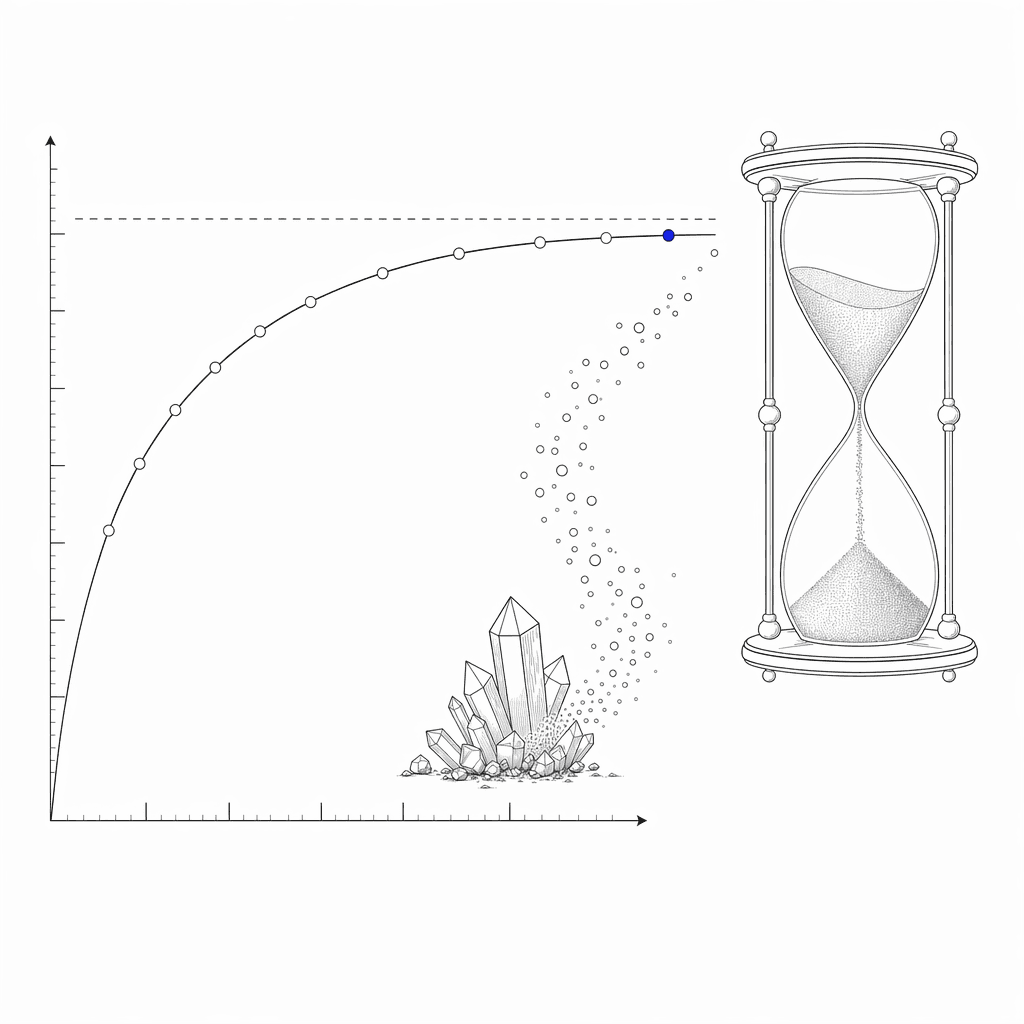
Combine reactions and click [Run time-evolution calculation] to get –
- Time curves of element concentrations and mineral amounts
- Approach of the saturation index SI to equilibrium (why dissolution slows)
- Parent and daughter curves of decay chains (Bateman check)
- Summary of pH, SI and remaining mineral amounts at the end time
What changes when time is included – the place of kinetics
What equilibrium calculations do not answer
An equilibrium calculation tells you where a system ends up, but not when it gets there. Many processes in a disposal environment are slower than equilibrium. Corrosion products of the disposal canister metal accumulate over long periods, alteration of buffer minerals is slower still, while groundwater mixing and pH buffering are much faster. Which processes are slow matters in the safety case, because the conditions for other processes change while a slow process runs. This page adds that time axis to the calculation.
Three reaction types on one time axis
Mineral dissolution and precipitation are calculated with the rate laws built into PHREEQC. The rate scales with how far the solution is from saturation, so it slows as the saturation index approaches zero, and the curve flattens. First-order removal is the simplest model: the species disappears in proportion to its concentration, defined by a single half-life. Use it to approximate processes whose mechanism is not known in detail, such as microbial reduction or irreversible fixation.
In a decay chain, the daughter nuclide grows in as the parent nuclide decays. The ratio of the two half-lives sets the shape of the curves. If the daughter lives much longer than the parent, it accumulates without reaching equilibrium; in the opposite case, the daughter curve follows the decline of the parent. The americium–neptunium pair in the example is the first case: the long-lived daughter remains after the parent is gone and dominates long-term safety.
Reading results and choosing the duration
A flat curve means the system is close to equilibrium; a curve that still slopes means the duration is too short. Reading the mineral and concentration curves together shows which mineral is a source and which is a sink. A decay curve is exponential and halves with each half-life, so on a linear axis it looks steep only at the start. If the time unit does not match the scale of the process, the curves bunch up at one end; if a result looks odd, change the duration first.
Assumptions of this calculation
The parameters of the built-in rate laws are tied to the experimental conditions under which they were measured (temperature · reactive surface area · solution composition). Applied unchanged to other conditions, the absolute values can be wrong, so rely only on relative trends. This page is a batch calculation without flow. Reactions in flowing water are handled by the Transport simulator; both pages treat decay with the same formulation. The equilibrium basics are in the Calculator and the Glossary, and the scope of application is in the Disclaimer.