New here? – How to use this page
Enter the composition of a water sample and the PHREEQC engine calculates the equilibrium state (pH, ionic strength, mineral saturation indices). A selenium–iron groundwater (Se, Fe, NaCl) is loaded as an example – see right away that under oxidizing conditions iron oxides precipitate while selenium does not.
- Enter the components – Enter element symbols (Se, Fe, Na…) and concentrations. An example is already loaded, so you can press [Calculate] right away.
- Select minerals for the saturation index – Enter the names of minerals whose precipitation you want to check (Se(s), FeSe2, Magnetite, etc.) and their SI is calculated. SI > 0 means supersaturated (tendency to precipitate).
- Interpret the results – The equilibrium pH, ionic strength, charge balance error and an SI gauge for each mineral are shown. Save a report with [Download Excel].
To estimate sorption constants (log K) from experimental data, go to the Fitting tab at the top.
Solution composition
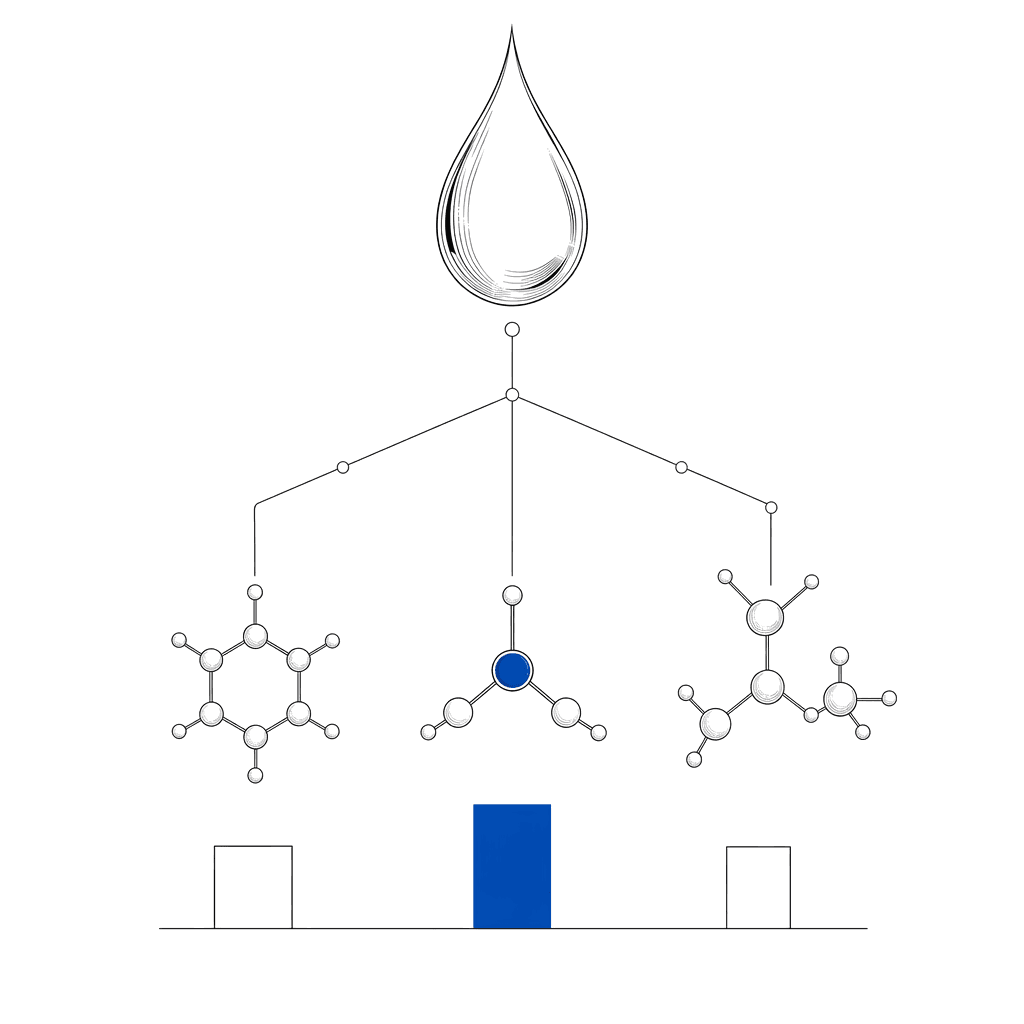
Enter the solution conditions and press [Calculate] to get –
- Equilibrium pH, pe, ionic strength and a charge balance check
- Speciation table and fraction chart for each element
- Mineral saturation index (SI) gauges – precipitation or dissolution
- Solubility limit and mineral equilibrium results (when selected)
What this laboratory calculates and how to read it
Why aqueous chemistry comes first in disposal safety
The safety of deep geological disposal of radioactive waste ultimately comes down to how far and how fast radionuclides travel with groundwater. The starting point is the form in which a radionuclide exists in groundwater. The same element forms species of different charge depending on its oxidation state and the ions dissolved with it, and that charge and size govern how strongly it is held on mineral surfaces and how much can remain dissolved in water.
The selenium–iron system loaded as the example is a typical case. In oxidized groundwater, selenium stays as anionic oxyanions that sorb weakly and are highly mobile, but under reducing conditions it precipitates as elemental selenium or iron selenide and is effectively immobilized. Which of the two applies is decided by pH and redox potential, and this calculator makes exactly that determination using a thermodynamic database.
Reading the results – speciation, saturation index, charge balance
The results come in three groups. Speciation shows, for each element, what fraction of the total each form accounts for. Whether the dominant species is an anion, a neutral molecule or a cation becomes the input for the next step, the sorption and transport calculations. The saturation index (SI) states by its sign whether the solution is supersaturated or undersaturated with respect to a mineral. A positive value means the mineral tends to precipitate, a negative value means it tends to dissolve, and a value near zero means equilibrium. SI, however, indicates a tendency, not a rate. A mineral with slow nucleation may not precipitate for a long time even when supersaturated, and that time axis is handled by Kinetics.
The charge balance error is a diagnostic of the input, not a result. A large mismatch between cation and anion equivalents means an analyte is missing or a unit was entered incorrectly, so a large error should make you check the composition first. Ionic strength sets the size of the activity correction, and the higher it becomes, the further it moves outside the valid range of models intended for dilute solutions.
The chain of questions linking the four tools
This laboratory sets out four questions in sequence on a single calculation engine. The calculator on this page answers “what form do the radionuclides take in this water now, and what precipitates?” Fit laboratory statistically estimates surface complexation constants or ion exchange selectivity coefficients from laboratory sorption data. Kineticsanswers “how long does it take to reach equilibrium?”, and Transport simulatoranswers “how much later than a tracer does a radionuclide emerge after passing through the buffer or host rock?” Because each step is designed so that its results become the input to the next, constants saved in fitting can be carried directly into the transport calculation.
If you are not sure where to start, Scenarios walks through verification examples based on Korean disposal conditions in order, and Glossary defines each concept. The relationship between the three original programs and this laboratory is summarized in About.
Data sources and limitations of this calculation
The chemical calculations are performed by the original PHREEQC library distributed by the U.S. Geological Survey, and the thermodynamic constants come from the public databases bundled with it (USGS, U.S. Environmental Protection Agency, Lawrence Livermore National Laboratory, ThermoChimie and others). Each database covers different elements and minerals, so if an element you need is not in the list you must choose another database, and that difference can appear as a difference in the results.
The calculation assumes equilibrium. Reactions that are slow in reality, such as redox reactions, are treated as reaching equilibrium instantly, so in systems where that assumption does not hold the results should be read only as tendencies. Models for high-salinity solutions do not support surface complexation. This tool is for education and research and does not replace licensing safety assessments or regulatory submissions. Detailed terms are in the Disclaimer.
Concept notes
The concepts needed to read the results are collected separately in Notes – what the distribution coefficient Kd captures and what it leaves out, how the compacted bentonite buffer holds radionuclides, and how redox changes the mobility of technetium, selenium and uranium, explained with values from published Korean literature.